

The Process
How are we spending our time on your business.
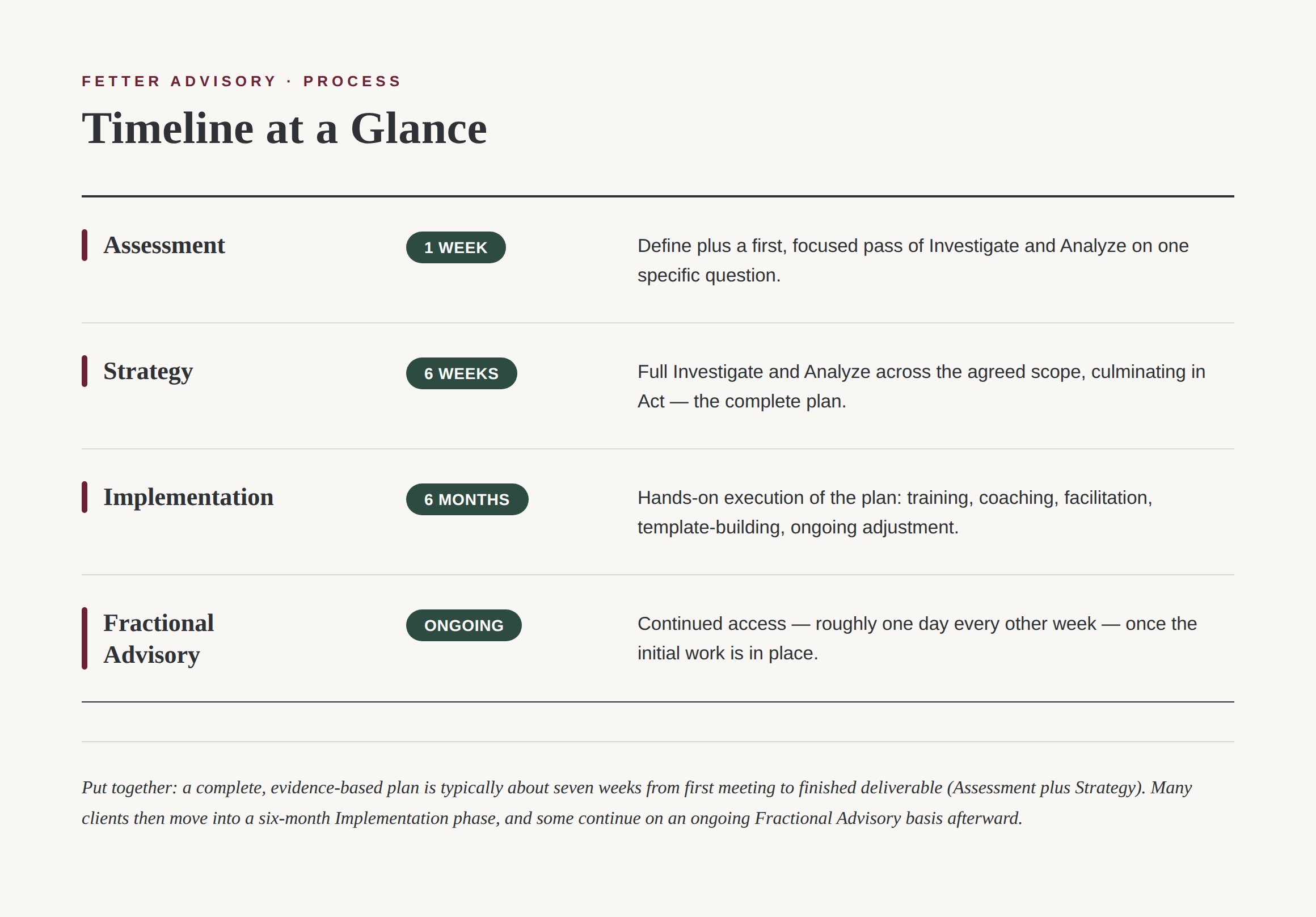
Our homepage and Approach page describe the shape of how we work: Define, Investigate, Analyze, Act. This page is what that actually looks like in practice — the meetings, the coordination, the time each phase takes, and why.
Define
This starts with a working session with you and whoever else needs to be in the room — not a quick call, a real conversation to get the question right. Ahead of that meeting, you'll complete a short intake questionnaire covering the basics of how your organization runs and where you already suspect the friction is. We'll also review whatever you already have — your website, past client or staff communications, existing survey or review data. That combination is what lets us come back with a written scope: the specific question this engagement will answer, confirmed with you before any research begins.
Investigate
This is where most of the time and coordination goes. Depending on scope, it typically includes individual interviews across several groups — leadership, staff, and customers or clients, sometimes community members or partners — each requiring its own guide and its own scheduling around real people's real calendars. It includes a full review of existing documents, communications, and data, and, where useful, direct observation: sitting in on how a handoff actually happens, not just how it's described. For a broader group, a short structured survey fills in what individual interviews can't reach at scale. None of this is guesswork dressed up as research — it's the evidence the recommendations later stand on.
Analyze
Every interview, document, and data point gets coded and cross-referenced against everything else — looking for what repeats, what the evidence confirms or contradicts, and where the friction actually sits versus where everyone assumed it did. Early patterns get tested against additional evidence rather than accepted on the first pass. Findings are then ranked two ways: how much each one is actually costing the organization, and how realistically it can be fixed with the resources you have. What comes out the other side is a small number of root causes, each with the evidence behind it — not a list of opinions.
Act
This is where research becomes strategy, and strategy becomes something you can actually run. Findings translate into specific, prioritized recommendations — then into the tools your organization needs to act on them: communication frameworks, stakeholder maps, messaging, decision protocols, templates, training materials. A live working session walks your leadership team through what was found and helps you decide what changes first. You leave with a written plan and a prioritized 30/60/90-day implementation roadmap, with the option to bring us back for hands-on Implementation support or a 30-day follow-up to see what's working and adjust.
More Than a Report
Fetter Advisory isn't built around "I'll study your organization and tell you what I found." It's built around figuring out what's getting in the way, helping you decide what needs to change, and giving you the strategy and tools to actually change it. Research establishes the credibility — the decision-making and implementation are what you're really buying.
A typical engagement moves through:
Research → Diagnosis → Strategy → Tools → Implementation Roadmap → Leadership Working Session → Follow-Through
Along the way, that means:
— Interviewing leadership, staff, customers or clients, and other stakeholders as the question calls for
— Reviewing your existing processes, communications, data, policies, and feedback
— Identifying exactly where trust, communication, decision-making, or structure is breaking down
— Translating findings into specific, prioritized strategic recommendations
— Building the actual tools you need — communication frameworks, stakeholder maps, messaging, decision protocols, templates, training materials
— Walking your leadership team through the findings in a live working session
— Handing you a prioritized 30/60/90-day implementation roadmap, not a generic recommendations chapter
— Optionally, checking back in 30 days to see what's working and adjust
There is a written deliverable — your Strategic Action Plan — but it isn't the point of the engagement. It's the record of the thinking. The tools, the working session, and the roadmap are what actually change how your organization operates.
Why it's built this way
The point of running the full process — not just guessing at a fix — is that what you get at the end holds up under use. That shows up in a few places at once: clearer internal communication, so staff know what's expected of them and why; more consistent client- or customer-facing communication, so the people you serve experience the trust you're trying to build; stronger standing with the community or public where that matters; and a marketing team working from the same evidence-backed message instead of guessing at what to say.