
Trees Are Water Infrastructure (Even If Nobody's Paying You For That Yet)
A tree service owner and I were talking a while back about a bid he'd lost. He described his work the way most people in his industry describe it: pruning, removals, stump grinding, cleanup. Good, honest work. Priced by the job.
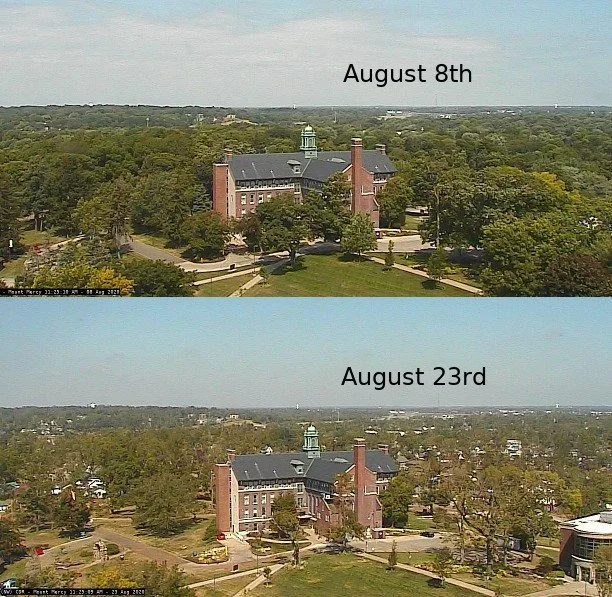
Photo of the derecho August 10th, 2020 and the tree canopy aftermath in Iowa.
I heard something else. Canopy cover slows and filters stormwater. Root systems hold soil in place and keep it out of the nearest creek. A healthy, well-managed tree is quietly doing the same job as a detention pond or a retaining wall — nobody's writing that into the invoice, and nobody's paying for it like infrastructure, because nobody's calling it infrastructure.
That conversation has stuck with me, because I think it points at something a lot of small, physical-work businesses are sitting on without realizing it. So I want to lay out what I'm actually seeing, in plain terms, because I think it's useful whether or not you ever hire anyone like me.
The industry is changing under your feet, whether you asked for it or not
Tree care right now is a roughly $1.7 billion industry, and it's consolidating fast. Private equity firms have started buying up established tree companies. Larger regional and national players are rolling up small, local operations. That's not automatically bad news for you — but it does change what "winning a bid" looks like.
ISA certification, once a nice-to-have, is becoming a prerequisite for bidding on larger contracts. Clients — especially municipal and commercial ones — are starting to expect performance-based contracts and digital reporting, not a handshake and an invoice. Insurance and liability costs are climbing, which raises the floor for what it costs to even compete. And on top of all that, the industry is short on skilled labor, same as almost every trade right now.
Put simply: the businesses that professionalize — systems, documentation, certifications, a way of proving the work was done right — are going to out-compete the ones that don't, even when the actual tree work is just as good. That's not a judgment. It's just where the market's heading, whether you decide to notice or not.
There's real money moving into water right now — and it's bigger than you'd think
Here's the part I don't think most landscaping, erosion-control, and tree-care owners have connected yet: water infrastructure funding in Colorado has roughly quintupled in the last few years. The federal infrastructure bill added about $680 million over five years to Colorado's State Revolving Fund program alone. More than $560 million has already gone out to over 60 Colorado communities for water and sewer work. The Colorado Water Conservation Board hands out another $37.7 million a year in grants — though competition is real; recent cycles have seen roughly twice as many applicants as the funding can support.
Real, large projects are moving because of this money, right now: a $396 million wastewater expansion in Colorado Springs, a new treatment plant in Arvada, a continuous pipe-replacement program in Longmont. This isn't abstract. It's happening in your market, this year.
None of that money is earmarked "for tree care" or "for landscaping." But the businesses that can speak the language of water infrastructure — that can walk into a conversation with a municipality or a developer and explain how their work reduces runoff, stabilizes soil, or protects a watershed — are the ones positioned to get pulled into bigger, better-funded conversations. The ones who stay "just" a tree service or "just" a landscaper are leaving the table before they ever sit down at it.
The part that actually worries me for you: being right isn't the same as being trusted
Here's where my other background comes in. Colorado's stormwater infrastructure was recently graded a C- by engineers reviewing the state's systems. That's not a knock on any one contractor — it's a sign the public doesn't fully trust what's being built, how it's being paid for, or whether it's actually working. I did a research study in grad school on exactly this: how a city communicates with residents about water issues. The technical answer was almost never the problem. The trust was.
So if you're hoping to get closer to this money — public hearings, municipal contracts, HOA or developer work tied to water management — being technically excellent won't be enough on its own. You'll also need to explain your work clearly to people who aren't engineers: city councils, HOA boards, worried neighbors, skeptical property owners. That's a muscle most field-service businesses have never had to build, because they've never needed it before. They're going to need it now.
What I'd actually do if I were you
Start calling your work what it actually is, even in small ways — on your website, in your bids, in conversation. If your work touches stormwater, erosion, or soil stability, say so plainly.
Look at what the bigger players in your industry are already doing — certifications, documentation, reporting — and pick one thing to start building this year, not because a bigger company told you to, but because it's coming either way.
And if you're ever in a room where you need to explain your work to people who aren't in your trade — a city council, an HOA board, a worried homeowner — practice saying it in plain language before you're asked to.
I care about this because I've spent my whole career believing that the people doing the real, physical work of taking care of a place — including the humblest version of that, pruning a tree so a root system doesn't fail someone's foundation — deserve the same seat at the table as the engineers and the policy people. You're already doing water's work. I just want you to get properly invited to that bigger table, with everything that comes with it.
If any of this is already on your mind — a bid you want to be ready for, a conversation with a municipality you don't quite know how to have yet — I'd genuinely like to hear about it. That's the kind of conversation I like best.
And if you know someone in this world — a landscaper, a land developer, someone running an HOA — who's circling this same question, send them my way. I'd rather have one honest conversation with someone who actually needs it than ten polished pitches to people who don't.
Jackie Fetter is the founder of Fetter Advisory, a strategic advisory firm based in Parker, CO. She works with owner-led businesses, land developers, HOA management companies, and municipalities on exactly this kind of problem — where the technical work is solid, but getting bigger, better-funded opportunities means being able to explain that work to people who aren't in the trade.
Draws from: Fetter Advisory's "Trees Are Water Infrastructure" LinkedIn series (Nov 2026); tree care industry market research; Colorado water infrastructure funding data (Colorado Watershed Assembly, CDPHE, CWCB); Jackie's graduate research